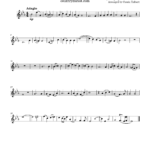
Download Allegro from Eine kleine Nachtmusik by Wolfgang Amadeus Mozart flute sheet music from The Country Flutist
Audio Preview
Eine kleine Nachtmusik (Serenade No. 13 for strings in G major), K. 525, is a 1787 composition by Wolfgang Amadeus Mozart (1756–1791). Its German title means “a little night music,” and it remains one of the most widely recognized pieces in classical music. The work originally contained four movements: Allegro, Romance, Menuetto, and Finale, though one movement is now believed to be lost.
Background
Mozart completed the serenade in Vienna on 10 August 1787, around the same time he was composing the second act of Don Giovanni. The exact purpose of the piece is unknown, and it is unclear whether it was performed during Mozart’s lifetime. Most scholars believe it was likely a commissioned work, though the details of the commission and its premiere remain unrecorded. The name Eine kleine Nachtmusik comes from Mozart’s own entry in his personal catalog, where he simply noted that he had completed a “little serenade.” The work was published posthumously around 1827 by Johann André, after Mozart’s widow Constanze sold a collection of his compositions to the publisher.
Music
The serenade is scored for a chamber ensemble of two violins, viola, cello, and double bass, though it is frequently performed by string orchestras. Its four movements are:
-
Allegro (G major)
-
Romance: Andante (C major)
-
Menuetto: Allegretto (G major, with trio in D major)
-
Finale: Rondo Allegro (G major)
I. Allegro
Duration: 5 minutes and 56 seconds
The opening movement is in sonata-allegro form. It begins with an ascending “Mannheim rocket” theme, immediately establishing a bright and energetic character. The second theme, in the dominant key of D major, is more graceful and lyrical. After the exposition, which is repeated, the development section explores keys including D minor and C major, creating tension and contrast. The movement concludes with a recapitulation in G major, bringing the spirited themes full circle.
Enjoyed this article? Download my FREE Flute Gift and receive 5 beginner hymns plus a printable practice tracker.