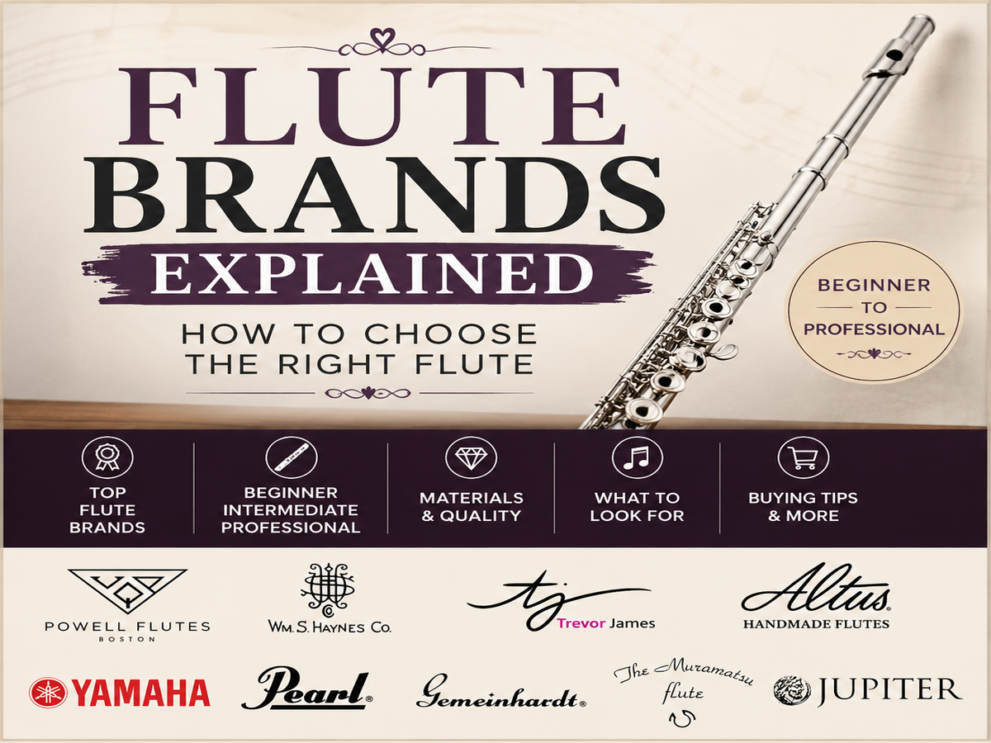
Flute brands explained doesn’t have to be complicated. If you’ve ever searched for a new flute, you’ve probably noticed just how many brands are available. Yamaha, Pearl, Gemeinhardt, Jupiter, Trevor James, Altus, Miyazawa, Muramatsu, and many others make instruments for beginning, intermediate, and professional players. So how do you know which brand is right for you?
The first thing to understand is that flute brands and flute models can generally be grouped into three playing levels: beginner, intermediate, and professional. These levels often correspond to differences in construction, materials, features, craftsmanship, and price.
Beginner, Intermediate, and Professional Flutes
Beginner flutes are generally designed to be affordable, durable, and relatively easy for new players to play. Many student instruments use nickel or nickel-based construction with a silver-plated finish. Their design emphasizes reliability and accessibility rather than expensive materials.
Intermediate flutes are designed for players who have developed their basic skills and are ready for an instrument with more advanced features and greater flexibility. Depending on the model, an intermediate flute may include a sterling silver headjoint, open holes, a B footjoint, or other upgraded features.
Professional flutes are made for advanced players who need a high level of responsiveness, tonal flexibility, and precision. Professional instruments may incorporate sterling silver, gold, or other precious metals, along with more extensive craftsmanship and customization options.
However, more expensive materials do not automatically make a flute sound better for every player. The headjoint design, craftsmanship, setup, keywork, and the individual player’s technique all influence how an instrument sounds and responds.
For that reason, it’s important to think of the beginner, intermediate, and professional categories as general guidelines rather than strict rules. A well-designed instrument that fits your playing style can be a better choice than a more expensive flute that doesn’t feel comfortable in your hands.
 Why Do Flute Brands Matter?
A flute brand can tell you something about the instrument’s design, manufacturing quality, available models, and intended player level. However, the name on the flute is only part of the equation.
Two players can try the same model and have very different opinions about how it feels and sounds.
That’s because factors such as the headjoint, embouchure, keywork, tone, and individual playing style all affect how a flute performs.
Therefore, instead of asking only, “What is the best flute brand?”, it’s better to ask:
“Which flute is the best fit for me?”
Beginner Flute Brands
Once you understand what makes a beginner flute different from an intermediate or professional instrument, it becomes easier to compare brands. Beginning students generally need an instrument that is reliable, comfortable to play, and capable of producing a good sound without making the learning process unnecessarily difficult.
Several established manufacturers offer student flutes.
Yamaha
Yamaha is one of the best-known musical instrument manufacturers in the world and produces flutes for players at several levels.
Yamaha student and intermediate instruments are popular because they offer consistent manufacturing and features designed to support developing players.
For a beginning student, a Yamaha flute can be a good option when the particular model fits the student’s needs and budget.
Gemeinhardt
Gemeinhardt has a long history of producing flutes and is particularly well known among student and school-band players.
Their instruments can be found in music stores and school music programs throughout the United States.
Gemeinhardt offers models for different levels of players, making the brand worth considering when you’re shopping for a first flute or an upgrade.
Jupiter
Jupiter is another brand that produces student and intermediate wind instruments.
Jupiter flutes are commonly found in educational music settings, and the company offers instruments designed for developing musicians.
When comparing student flutes, it’s worth including Jupiter alongside other established brands rather than assuming that one manufacturer is automatically better than another.
Pearl
Pearl is especially interesting for flute players because of its distinctive approach to flute construction. I love my Pearl flute.
Pearl offers instruments ranging from student models to professional-level flutes. The company is also known for its pinless mechanism, which is designed to provide smooth key action and facilitate maintenance.
Pearl is a brand worth exploring if you’re looking for an instrument that can grow with you as your playing develops.
Intermediate Flute Brands
If you’ve been playing for a while, you may be ready to move beyond a basic student instrument. Intermediate flute brands offer models with additional features and materials designed to give developing players more flexibility as their technique improves.
At this level, you may encounter brands such as:
- Yamaha
- Pearl
- Gemeinhardt
- Jupiter
- Trevor James
- Altus
- Azumi
Intermediate flutes often include features that aren’t necessarily found on basic student instruments.
Depending on the model, you may find options such as a sterling silver headjoint, open holes, a B footjoint, offset or inline G, split E mechanism, or other upgraded features.
However, more features don’t automatically mean a flute is better for you.
Your teacher or an experienced flute player can be extremely helpful when you’re ready to move from a beginner instrument to an intermediate flute.
If you’re specifically shopping for an intermediate instrument, you may also want to read my guide to the best intermediate flutes.
Professional Flute Brands
Professional flute makers use a variety of precious metals and may offer extensive customization options. Advanced players often look for greater control over tone, dynamics, response, and intonation. At this level, manufacturers such as the following may be worth exploring:
- Muramatsu
- Miyazawa
- Altus
- Sankyo
- Powell
- Brannen
- Haynes
- Yamaha
- Pearl
Professional flutes can be made from a variety of precious metals and may offer extensive customization options.
The headjoint becomes particularly important because different designs can produce very different responses and tone colors.
Professional players often spend considerable time trying multiple instruments and headjoints before making a purchase.
Japanese Flute Brands
Several highly respected flute manufacturers are based in Japan.
Muramatsu, Miyazawa, Altus, Sankyo, Yamaha, and Pearl are examples of Japanese manufacturers with strong reputations among flute players.
Japanese flute makers are particularly well represented in the intermediate and professional markets.
That doesn’t mean that every Japanese flute will be the right instrument for every player. However, these manufacturers are certainly worth knowing when you’re researching higher-level instruments.
American and European Flute Makers
There are also important flute makers based outside Japan.
For example, Powell, Haynes, Brannen, and Burkart are associated with the American flute-making tradition.
European makers also have an important place in the professional flute world.
When shopping at the professional level, it’s useful to look beyond the brand name and pay attention to the individual instrument, headjoint, materials, craftsmanship, and how the flute responds to your playing.
What Makes One Flute Brand Different From Another?
Flute manufacturers may differ in several important areas.
Keywork
The design and feel of the keys can vary between manufacturers.
Some players prefer a lighter action, while others prefer a particular resistance or feel beneath their fingers.
Headjoint Design
The headjoint has an enormous influence on how a flute responds.
Even two flutes from the same manufacturer can feel very different if they have different headjoints.
For advanced players, headjoint selection can become just as important as the flute brand itself.
Materials
Student flutes are commonly made from silver-plated materials, while more advanced instruments may incorporate sterling silver or other precious metals.
However, don’t assume that more expensive materials automatically produce a better sound.
The design, craftsmanship, headjoint, and player all contribute to the final result.
Manufacturing
Different manufacturers use their own construction techniques. For example, Pearl uses a pinless mechanism, while other manufacturers take different approaches to keywork and construction. These design choices can affect maintenance, feel, and playability.
Does an Expensive Flute Sound Better?
Not necessarily.
A more expensive flute may offer higher-quality materials, more refined craftsmanship, customization options, and a more sophisticated mechanism. However, that doesn’t mean every expensive flute will sound better to you.
A flute that responds easily and produces a beautiful tone in your hands may be a better choice than a more expensive instrument that doesn’t suit your playing style.
This is why trying an instrument before purchasing it is so important.
Should You Buy a Flute Based on the Brand?
No—not by brand alone.
Brand reputation is useful when narrowing down your choices, but it shouldn’t be the only factor.
When possible, try several instruments from different manufacturers.
Pay attention to:
- How easily the flute speaks
- How comfortable the keywork feels
- Whether the notes respond consistently
- How the instrument feels in your hands
- The tone across all three octaves
- Intonation
- How well you can control the dynamics
- Whether the flute feels comfortable after playing for an extended period
If you’re a beginner, have your flute teacher help you evaluate potential instruments.
What Flute Brand Is Best for a Beginner?
There isn’t one universal answer.
Yamaha, Pearl, Gemeinhardt, Jupiter, and other established manufacturers all offer instruments designed for beginning players.
Rather than choosing based solely on the name, consider the specific model, your budget, the instrument’s condition, and whether it has been properly adjusted.
A well-maintained used flute from a reputable manufacturer can sometimes be a much better choice than a brand-new inexpensive instrument from an unknown manufacturer.
What Flute Brand Is Best for an Intermediate Player?
Intermediate players have more choices.
At this level, you might compare models from Yamaha, Pearl, Gemeinhardt, Jupiter, Trevor James, Altus, Azumi, and other established manufacturers.
Your teacher can help you determine which features would actually benefit your playing.
For example, you may be ready for an open-hole flute, a B footjoint, or a sterling silver headjoint—but you don’t necessarily need every available upgrade.
The best intermediate flute is the one that gives you room to grow while remaining comfortable and responsive.
Don’t Forget About the Headjoint
One of the biggest mistakes flute shoppers make is focusing exclusively on the flute body.
The headjoint deserves serious attention.
A different headjoint can dramatically change how an instrument responds and how its tone feels to the player.
For that reason, advanced players often try several headjoints when shopping for an instrument.
If you’re upgrading to an intermediate or professional flute, ask whether you can try different headjoint options before making your decision.
New vs. Used Flutes
Another important question is whether you should buy a new or used instrument.
A new flute gives you the benefit of purchasing directly from a retailer with a warranty and, depending on the seller, adjustment or service support.
A used flute can potentially offer more instrument for your money.
However, condition matters enormously.
Before purchasing a used flute, have it examined by a qualified flute technician or repair specialist. Pads, mechanism adjustment, dents, leaks, and other problems can turn an inexpensive flute into an expensive repair project.
How to Choose the Right Flute Brand
When you’re researching flute brands, it’s easy to become overwhelmed by the choices.
Start by determining your playing level and budget. Then research reputable manufacturers that make instruments appropriate for your needs.
If you’re a beginner, focus on reliability, playability, comfort, and getting an instrument that is properly adjusted.
If you’re an intermediate player, consider which upgraded features will actually help you develop as a musician.
For professional players, individual instrument response, headjoint characteristics, craftsmanship, and customization may become much more important.
Most importantly, try the flute before you buy it whenever possible.
The best flute brand isn’t necessarily the one with the most famous name or the highest price. It’s the instrument that feels comfortable, responds well, fits your musical goals, and helps you become a better musician.
Final Thoughts on Flute Brands
Understanding flute brands explained doesn’t mean memorizing every manufacturer or model on the market.
Instead, think about the three major categories—beginner, intermediate, and professional—and then look at the brands that make instruments appropriate for your level.
Yamaha, Pearl, Gemeinhardt, Jupiter, Trevor James, Altus, Miyazawa, Muramatsu, and many other manufacturers offer different options for different players.
The right flute is ultimately a personal choice.
A flute with a respected brand name isn’t automatically the right instrument for you, and the most expensive flute isn’t necessarily the one you’ll enjoy playing the most.
Try different instruments when possible, ask an experienced flute player or teacher for advice, and pay attention to how the instrument feels and responds in your own hands.
With the right flute, practicing can become more enjoyable, your technique can continue to develop, and you can focus on what matters most—making music.

You Might Also Like: