
Moving from a beginner flute to an intermediate instrument can be an exciting milestone. At this stage, you’re likely playing more challenging repertoire, developing greater control over your tone and intonation, and beginning to think more seriously about your future as a musician.
But how do you know when it’s time to upgrade? And what should you look for when choosing the best intermediate flute?
There isn’t one flute that is perfect for every player. Intermediate flutes vary in materials, key configurations, headjoint designs, and price. Your hand size, embouchure, air stream, playing goals, and preferred tone all matter.
This guide will help you understand what makes an intermediate flute different, when you might be ready for an upgrade, and which intermediate flute brands and models are worth considering.
What Is an Intermediate Flute?
The term intermediate flute can be confusing because there isn’t one universal standard that determines when a flute becomes an intermediate instrument. Manufacturers and music retailers may also use terms such as step-up flute or advanced student flute.
Generally, an intermediate flute is designed for a player who has moved beyond the beginner stage and wants an instrument with additional features, improved response, and greater flexibility.
Depending on the model, an intermediate flute may offer:
- A sterling-silver or upgraded silver headjoint
- Open-hole or French-style keys
- A B footjoint
- A Split-E mechanism
- More advanced keywork
- Different G-key configurations
- Improved materials and construction
- More headjoint options
- Greater tonal flexibility
However, more features don’t automatically make a flute better for every player. The best intermediate flute is the one that feels comfortable, responds well to your playing, and helps you produce the sound you want.
 When Should You Upgrade to an Intermediate Flute?
Buying a more expensive flute doesn’t automatically make someone a better flutist. Your fundamentals—tone production, breath support, intonation, articulation, and technique—are still extremely important.
You may be ready to consider an intermediate flute if:
- You’ve been playing consistently for several years.
- You’re comfortable with the basic range of the flute.
- You’re beginning to study more challenging repertoire.
- You’re preparing for high-school auditions or advanced music programs.
- You’re considering college music study.
- Your current instrument is limiting your tone, response, or technical development.
- Your flute teacher recommends that you consider an upgrade.
On the other hand, if you’re still learning fundamental fingerings, developing your embouchure, or struggling with basic tone production, you may not need an expensive upgrade yet.
Talk with your flute teacher before making a major purchase. An experienced teacher can often tell you whether your current instrument is actually holding you back.
What Should You Look for in an Intermediate Flute?
Before comparing brands, it’s important to understand the features you’ll encounter.
Headjoint Material
The headjoint has a significant effect on the way a flute responds and sounds.
Many intermediate flutes feature a sterling-silver headjoint combined with a silver-plated body. Pearl, for example, currently offers intermediate models ranging from silver-plated instruments to flutes with .925 sterling-silver headjoints, bodies, and footjoints.
A sterling-silver headjoint doesn’t automatically produce a “better” sound, but it can offer a different tonal response and color than a completely silver-plated instrument.
The cut and design of the headjoint are also extremely important. Two flutes made from similar materials can feel completely different because of their headjoint design.
Open-Hole vs. Closed-Hole Keys
Many advancing flutists eventually move to an open-hole, or French-key, flute.
Open-hole keys can encourage precise finger placement and are required for some extended techniques. They are also common on higher-level instruments.
However, you don’t need open holes simply because you’re an intermediate player.
A well-made closed-hole flute can be an excellent choice, especially if you are more comfortable with that configuration or if your teacher doesn’t think you need to make the transition yet.
If you are considering open holes, make sure you can comfortably cover the tone holes with your fingers. Your hand size and finger placement matter.
C Footjoint vs. B Footjoint
A standard C footjoint gives the flute a range down to middle C. A B footjoint adds one additional semitone, allowing the flute to play low B.
A B foot can also affect the feel and balance of the instrument and may be useful for certain advanced repertoire.
However, a B foot isn’t essential for every intermediate player.
If you’re primarily playing standard student repertoire, a C foot may serve you perfectly well. If you’re preparing for advanced repertoire, auditions, or professional study, a B foot may be worth considering.
Offset G vs. Inline G
The G-key configuration is another consideration.
An offset G places the G keys slightly differently to accommodate the natural position of the hand. Many players find it comfortable, particularly if they have smaller hands.
An inline G keeps the G keys in line with the other keys and is common on more advanced instruments.
Neither configuration is automatically superior.
Comfort should be the deciding factor.
Split-E Mechanism
The high E can sometimes be difficult to produce cleanly and consistently on the flute.
A Split-E mechanism modifies the keywork to make high E more stable and easier to produce.
Some intermediate models offer this feature, while others don’t. Yamaha, for example, offers Split-E on selected models in its 300 and 400 series.
If you frequently have difficulty with high E, a Split-E mechanism may be worth considering.
Best Intermediate Flute Brands and Models
There are many excellent instruments available, so this isn’t a ranking from “best” to “worst.” Instead, these are intermediate flute models worth considering when you’re ready to upgrade.
Always try an instrument before buying it whenever possible.
1. Yamaha YFL-362H
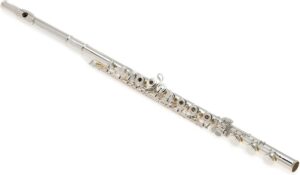
Yamaha’s 300 series is a popular choice for advancing students.
The YFL-362H features ring keys, an offset G, a B footjoint, and a sterling-silver headjoint with a nickel-silver body and footjoint. Yamaha classifies its 400/300/200 lineup as student and intermediate instruments.
Why consider it?
- Sterling-silver headjoint
- Ring keys
- Offset G
- B footjoint
- Available with Split-E
- Established Yamaha reputation
The YFL-362H is a strong option for a serious student who wants to move into a more advanced instrument without immediately entering the professional-flute price range.
2. Yamaha YFL-462H
If you’re looking for more silver construction, the YFL-462H is another model worth considering.
Yamaha lists the 462 among its intermediate flutes, and the model combines a sterling-silver headjoint with a sterling-silver body and footjoint.
Why consider it?
- Sterling-silver headjoint
- Sterling-silver body
- Sterling-silver footjoint
- French-style keys
- Available with B footjoint
- Yamaha craftsmanship
This may appeal to players looking for a more substantial upgrade while remaining below many fully professional handmade instruments.
3. Pearl Quantz 665
Pearl’s Quantz 665 is another model worth considering when shopping for an intermediate flute.
Pearl currently lists the 665 in its Intermediate Series. It has a .925 sterling-silver headjoint with a silver-plated body, footjoint, and mechanism. Pearl also offers several configurations and optional features within the Quantz line.
Why consider it?
- .925 sterling-silver headjoint
- Silver-plated body and mechanism
- Multiple configuration options
- Pearl’s Pinless mechanism
- Optional advanced features
The 665 is particularly interesting because Pearl offers a wide range of options that allow players to choose features according to their needs and playing level.
4. Pearl Quantz 765
For players looking for more sterling-silver construction, the Pearl Quantz 765 is another model worth investigating.
Pearl lists the 765 in its Intermediate Series with a .925 sterling-silver headjoint, body, and footjoint, along with a silver-plated mechanism.
Why consider it?
- Sterling-silver headjoint
- Sterling-silver body
- Sterling-silver footjoint
- Silver-plated mechanism
- Intermediate-level design
This is an option for the serious student who wants to move toward a more substantial silver instrument.
5. Azumi AZ2SRB
Azumi flutes are designed with Altus headjoints and are another popular choice among advancing players.
The AZ2SRB features an Altus Professional .925 sterling-silver Z-Cut headjoint, silver-plated body and mechanism, open holes, inline G, and a B footjoint with Gizmo key.
Why consider it?
- Altus .925 sterling-silver headjoint
- Z-Cut headjoint
- Open holes
- Inline G
- B footjoint
- Gizmo key
- French-style pointed key arms
This model may appeal to an advancing player who wants an instrument with several features commonly associated with more advanced flutes.
6. Gemeinhardt 3SHB
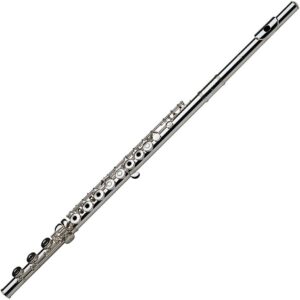
Gemeinhardt specifically identifies the 3SHB as an intermediate flute and describes it as one of its step-up models.
Depending on configuration, the 3SHB can include features such as a solid-silver headjoint, open-hole keys, B footjoint, and optional Split-E and offset G.
Why consider it?
- Established flute manufacturer
- Solid-silver headjoint options
- Open-hole design
- B footjoint
- Step-up configuration
- Multiple options
Gemeinhardt has been making flutes for generations, making it a brand worth including in your research.
Which Intermediate Flute Is Best for You?
There isn’t one universal answer.
The best intermediate flute depends on your individual needs.
If you prefer a comfortable, familiar feel:
An offset-G flute may be a good choice.
If you’re preparing for more advanced repertoire:
Consider features such as a B footjoint, open holes, and Split-E mechanism.
If tone is your primary concern:
Try several different headjoints and compare them rather than choosing based solely on the metal used.
If you have smaller hands:
Pay particular attention to ergonomics and key placement.
If you’re preparing for college music study:
Ask your private teacher or flute professor what instruments they recommend and whether you should be looking at intermediate, pre-professional, or professional models.
How Much Should You Spend on an Intermediate Flute?
There isn’t one price that defines an intermediate flute.
Prices vary significantly depending on:
- Brand
- Materials
- Headjoint
- Key configuration
- Footjoint
- Handmade vs. production construction
- Additional mechanisms
- New vs. used condition
Rather than choosing an instrument based solely on price, think about what you’re actually getting for the money.
A more expensive flute isn’t necessarily better for you.
If you’re shopping on a budget, a well-maintained used instrument from a reputable dealer can sometimes be an excellent alternative to buying new.
Should You Buy a New or Used Intermediate Flute?
Both options have advantages.
Buying New
A new flute gives you:
- A manufacturer’s warranty
- A new mechanism and pads
- Dealer support
- The ability to choose your exact configuration
Buying Used
A used flute may give you access to a higher-level instrument at a lower price.
However, condition is extremely important.
Before buying a used flute, have it inspected by a qualified flute repair technician. A flute that looks beautiful can still need expensive mechanical work.
Always Try Before You Buy
This is one of the most important pieces of advice I can give an advancing flutist.
Don’t choose an intermediate flute simply because someone online says it’s the “best.”
If possible, try several instruments.
Play the same:
- Long tones
- Scales
- Arpeggios
- Technical exercises
- Soft passages
- Loud passages
- High notes
- Low notes
- Pieces from your current repertoire
Pay attention to how easily each flute responds.
Listen to your tone.
Notice whether the keys feel comfortable.
And if you’re able to, have your flute teacher listen to you play the instruments. Sometimes another musician can hear differences that you don’t notice while you’re playing.
How to Take Care of Your Intermediate Flute
Once you’ve invested in a better instrument, proper maintenance becomes even more important.
After playing, remove moisture according to the care instructions provided by the manufacturer. Wipe fingerprints from the exterior and store the flute safely in its case.
Avoid exposing the instrument to extreme temperatures or sudden temperature changes.
Don’t attempt to adjust or repair the mechanism yourself unless you’re trained to do so. If you notice sticky keys, leaking pads, unusual noises, or mechanical problems, take the flute to a qualified repair technician.
Regular professional maintenance can help keep your instrument playing properly for years.
An Intermediate Flute Is a Tool for Your Musical Growth
Upgrading your instrument can be exciting, but remember that the flute itself isn’t what makes you a better musician.
Your practice habits, teacher, fundamentals, listening skills, and musical curiosity matter just as much.
An intermediate flute should support your development by giving you the response, comfort, and tonal flexibility you need to continue growing.
If you’re working toward more advanced repertoire, you may also enjoy my guide to 10 Fun Intermediate to Advanced Flute Solos to Hone Your Skills.
And if you’re ready to work with a teacher, you can learn more about private flute lessons.
Final Thoughts
Choosing the best intermediate flute is a personal decision. Yamaha, Pearl, Azumi, and Gemeinhardt all offer instruments worth considering, but the right flute for one player may not be the right flute for another.
Focus on the features that actually matter to your playing:
- Comfortable keywork
- A responsive headjoint
- Good intonation
- A tone you enjoy
- Appropriate construction and materials
- Features that match your musical goals
- A price that fits your budget
Most importantly, try before you buy whenever possible.
An intermediate flute should inspire you to practice, explore new repertoire, and continue developing as a musician. Take your time, ask your teacher for advice, and choose the instrument that feels and sounds right for you.
Happy practicing! 🎶
Enjoyed this article? Download my FREE Flute Gift and receive 5 beginner hymns plus a printable practice tracker.


You Might Also Like:




About the author: Cascia Talbert, known as The Country Flutist, is a professional performer, composer, arranger, music producer and music teacher.